Address
Work Hours
Monday to Friday: 7AM - 7PM
Weekend: 10AM - 5PM

Address
Work Hours
Monday to Friday: 7AM - 7PM
Weekend: 10AM - 5PM



Key definition: An HS code (Harmonized System code) is the internationally standardized 6-digit number used to classify a traded product for customs, duties, and trade statistics. For Egyptian fresh produce, the most-used codes are 0804.50 for mangoes, 0805.10 for oranges, 0805.21 for mandarins, 0805.50 for lemons and limes, 0806.10 for fresh grapes, and 0810.90 for pomegranates. The first 6 digits are identical worldwide; importing countries add 2–4 more digits for their own tariff lines.
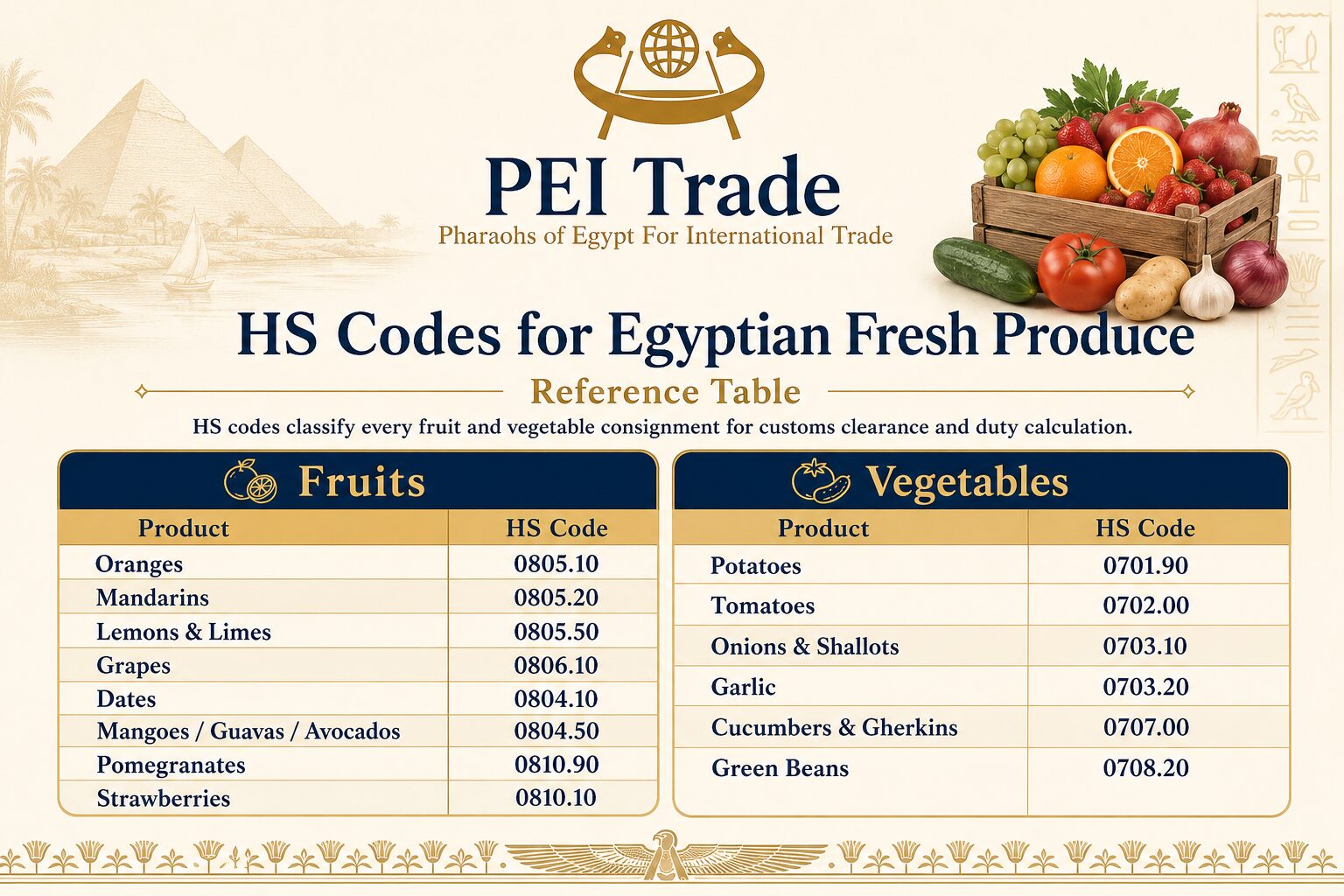
The Harmonized System (HS) is an internationally standardized system of names and numbers used to classify traded products. It is maintained by the World Customs Organization (WCO) and used by more than 200 countries as the basis for customs tariffs and trade statistics. Every fresh produce consignment leaving Egypt is assigned an HS code that determines its import duty, applicable regulations, and how it is recorded in trade data.
For exporters and importers, the HS code is the single most important classification on the commercial invoice, packing list, and customs declaration. An incorrect code can lead to wrong duty calculation, customs delays, or rejected shipments. This reference page lists the HS codes for the fruits and vegetables Egypt exports most, using the current HS 2022 edition of the nomenclature.
An HS code is built from progressively more specific levels. Using mangoes (0804.50) as an example:
Throughout this page we list the internationally standardized 6-digit subheadings. Always confirm the full 8–10 digit tariff line for your specific destination market before shipping.
The table below lists the HS subheadings (Chapter 08) for the fresh fruits Egypt exports, with the typical Egyptian export season for each. Citrus and mango are Egypt’s flagship fruit exports — see our Complete Guide to Egyptian Citrus Export and Egyptian Mango Export Guide for specifications, varieties, and sourcing.
| Produce | HS Code (6-digit) | HS Description | Egypt Peak Season |
|---|---|---|---|
| Oranges | 0805.10 | Oranges, fresh or dried | Dec–Apr (Navel); Mar–Aug (Valencia) |
| Mandarins / Tangerines | 0805.21 | Mandarins, incl. tangerines and satsumas | Nov–Mar |
| Clementines | 0805.22 | Clementines, wilkings and similar hybrids | Nov–Feb |
| Lemons & Limes | 0805.50 | Lemons and limes, fresh or dried | Year-round |
| Grapefruit | 0805.40 | Grapefruit, including pomelos | Nov–Apr |
| Mangoes | 0804.50 | Guavas, mangoes and mangosteens | Jun–Nov |
| Grapes (fresh) | 0806.10 | Grapes, fresh | May–Aug |
| Pomegranates | 0810.90 | Other fruit, fresh (incl. pomegranates) | Sep–Dec |
| Strawberries | 0810.10 | Strawberries, fresh | Dec–Apr |
| Dates | 0804.10 | Dates, fresh or dried | Aug–Nov |
| Figs | 0804.20 | Figs, fresh or dried | Jun–Sep |
| Watermelons | 0807.11 | Watermelons, fresh | Apr–Jul |
| Melons (other) | 0807.19 | Melons (excl. watermelons), fresh | Apr–Sep |
| Apricots | 0809.10 | Apricots, fresh | May–Jun |
| Peaches & Nectarines | 0809.30 | Peaches, including nectarines, fresh | May–Aug |
Fresh vegetables are classified under Chapter 07 (Edible vegetables and certain roots and tubers). Potatoes, onions, and garlic are Egypt’s leading vegetable exports by volume.
| Produce | HS Code (6-digit) | HS Description | Egypt Peak Season |
|---|---|---|---|
| Potatoes (ware) | 0701.90 | Potatoes, fresh or chilled (excl. seed) | Jan–May; Oct–Dec |
| Onions & Shallots | 0703.10 | Onions and shallots, fresh or chilled | Mar–Jun |
| Garlic | 0703.20 | Garlic, fresh or chilled | Apr–Jun |
| Tomatoes | 0702.00 | Tomatoes, fresh or chilled | Nov–May |
| Green Beans | 0708.20 | Beans (Vigna, Phaseolus), fresh or chilled | Oct–May |
| Sweet Potatoes | 0714.20 | Sweet potatoes, fresh, chilled or dried | Sep–Feb |
| Peppers (Capsicum) | 0709.60 | Fruits of genus Capsicum or Pimenta, fresh | Nov–May |
| Cucumbers & Gherkins | 0707.00 | Cucumbers and gherkins, fresh or chilled | Year-round (greenhouse) |
| Globe Artichokes | 0709.91 | Globe artichokes, fresh or chilled | Feb–May |
| Carrots & Turnips | 0706.10 | Carrots and turnips, fresh or chilled | Dec–Apr |
| Okra | 0709.99 | Other vegetables, fresh or chilled (incl. okra) | May–Oct |
Frozen (IQF) and dried produce move to different headings. Frozen vegetables are classified under heading 0710, frozen fruit under 0811, and dried vegetables under 0712. Egypt is a major exporter of frozen strawberries, IQF vegetables, and dehydrated onion and garlic.
| Produce | HS Code (6-digit) | HS Description |
|---|---|---|
| Frozen Strawberries | 0811.10 | Strawberries, frozen |
| Frozen Mango / Fruit | 0811.90 | Other fruit and nuts, frozen |
| Frozen Peas | 0710.21 | Peas (Pisum sativum), frozen |
| Frozen Green Beans | 0710.22 | Beans (Vigna, Phaseolus), frozen |
| Frozen Okra / Molokhia | 0710.80 | Other vegetables, frozen |
| Frozen Mixed Vegetables | 0710.90 | Mixtures of vegetables, frozen |
| Dried / Dehydrated Onions | 0712.20 | Onions, dried |
| Dried Garlic & Vegetables | 0712.90 | Other dried vegetables and mixtures |
The HS code on a shipment determines far more than a customs reference number. Using the correct classification affects:
To confirm the full tariff line for your destination, start from the 6-digit code in the tables above, then look up the national extension:
PEI Trade handles HS classification and full export documentation as part of every shipment. To discuss a specific product or market, contact our export team at [email protected]. For the full reference library, visit the PEI Trade Export Knowledge Base.
The HS code for fresh mangoes is 0804.50, which covers “guavas, mangoes and mangosteens.” This 6-digit subheading is the same in every country. Importing markets add their own 2–4 digits, for example 0804.50.00 in the EU CN nomenclature.
Fresh oranges are classified under 0805.10. Mandarins and tangerines are 0805.21, clementines are 0805.22, lemons and limes are 0805.50, and grapefruit is 0805.40.
The first 6 digits of an HS code are standardized worldwide by the World Customs Organization. Individual countries extend the code to 8 or 10 digits to define their own tariff lines and duty rates, so the same product may appear as a longer code at destination, but the first 6 digits never change.
Yes. Frozen vegetables move to heading 0710 (for example 0710.22 for frozen beans) and frozen fruit to heading 0811 (for example 0811.10 for frozen strawberries), rather than the fresh-produce headings in Chapters 07 and 08.
The codes on this page follow the HS 2022 edition, the current version of the Harmonized System maintained by the World Customs Organization. The WCO revises the nomenclature roughly every five years.
PEI Trade. “HS Codes for Egyptian Fresh Produce Export.” PEI Trade Export Knowledge Base. https://peitrade.com/knowledge-base/hs-codes-fresh-produce/