Address
Work Hours
Monday to Friday: 7AM - 7PM
Weekend: 10AM - 5PM

Address
Work Hours
Monday to Friday: 7AM - 7PM
Weekend: 10AM - 5PM


Pharaohs of Egypt for International Trade LLC · Cairo · HS 0804.50
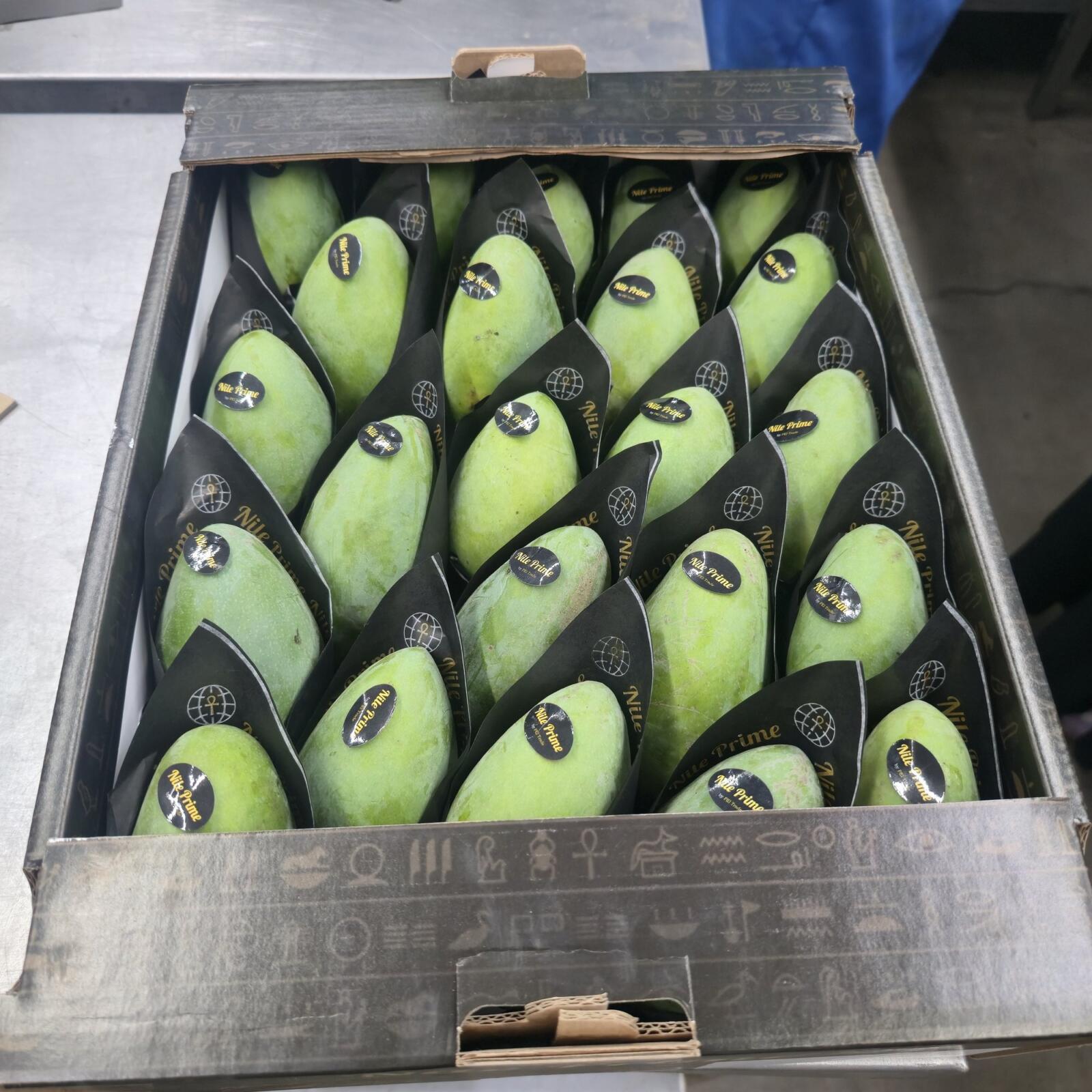
Keitt, Kent, Naomi, Zebda and Owais, graded by count into 5 kg export cartons. Full 40 ft reefer loads out of Damietta, Alexandria, Port Said and Ain Sokhna. Send us a port and a volume and a price comes back the next working day.
Sunday to Thursday, 09:00–17:00 Cairo time (UTC+2) · [email protected]
Jul–Nov
Egyptian season, five months
20,800 kg
Net in a 40 ft reefer, 5 kg cartons
10–12 °C
Carrying temperature — not the produce default
6–16
Counts we pack — nothing else
Shipping this month — updated 27 August 2026. Owais and Zebda at peak. Kent has started. Keitt opens in September and runs to November.
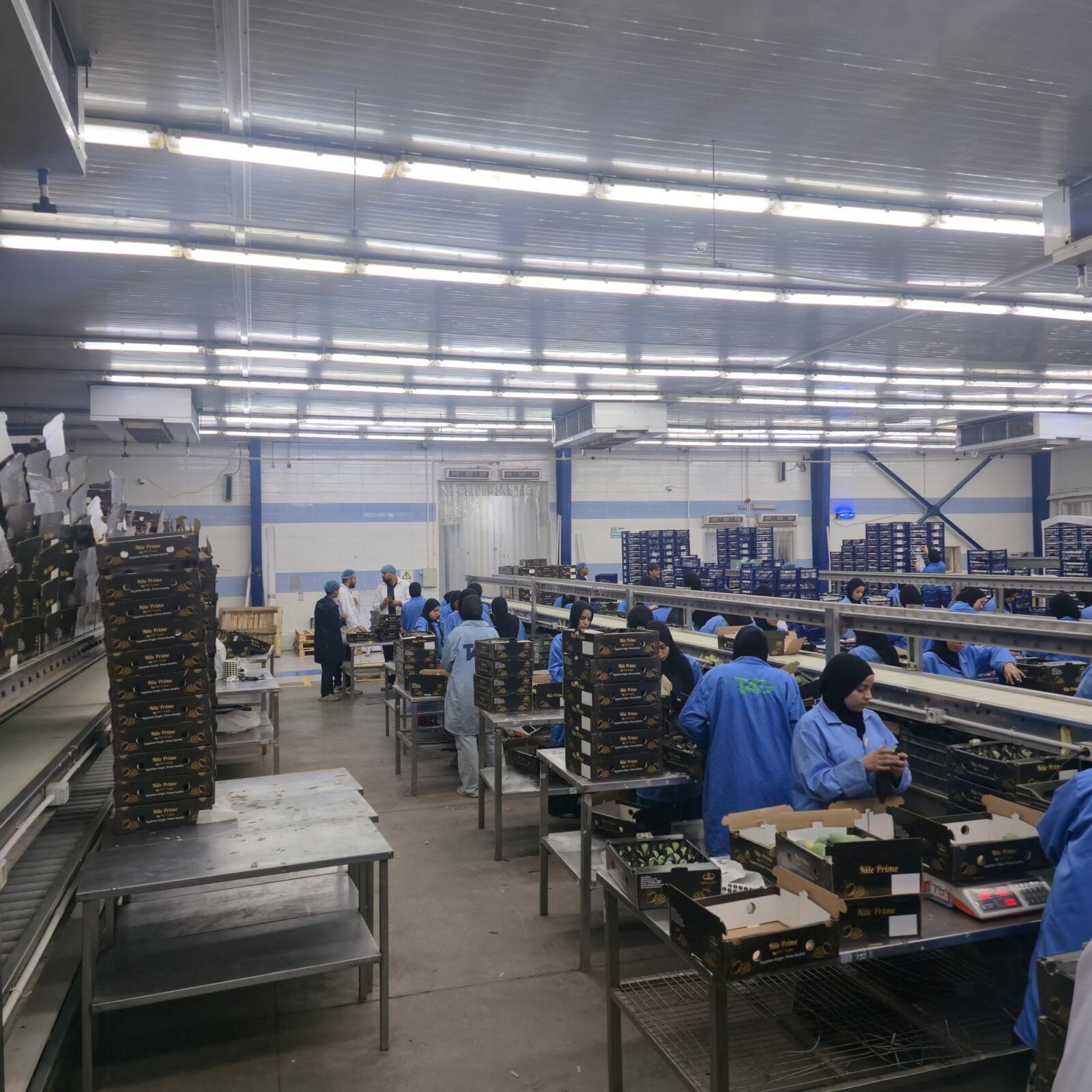
We do not own the farms and we do not hold the food-safety certificates ourselves. We source from growers and packing houses that hold them, and supply the documents with every shipment. Ask for the packhouse certificate before you order and we will send it, with the number, so you can check it on the certifying body’s own database. See what each certificate actually covers.
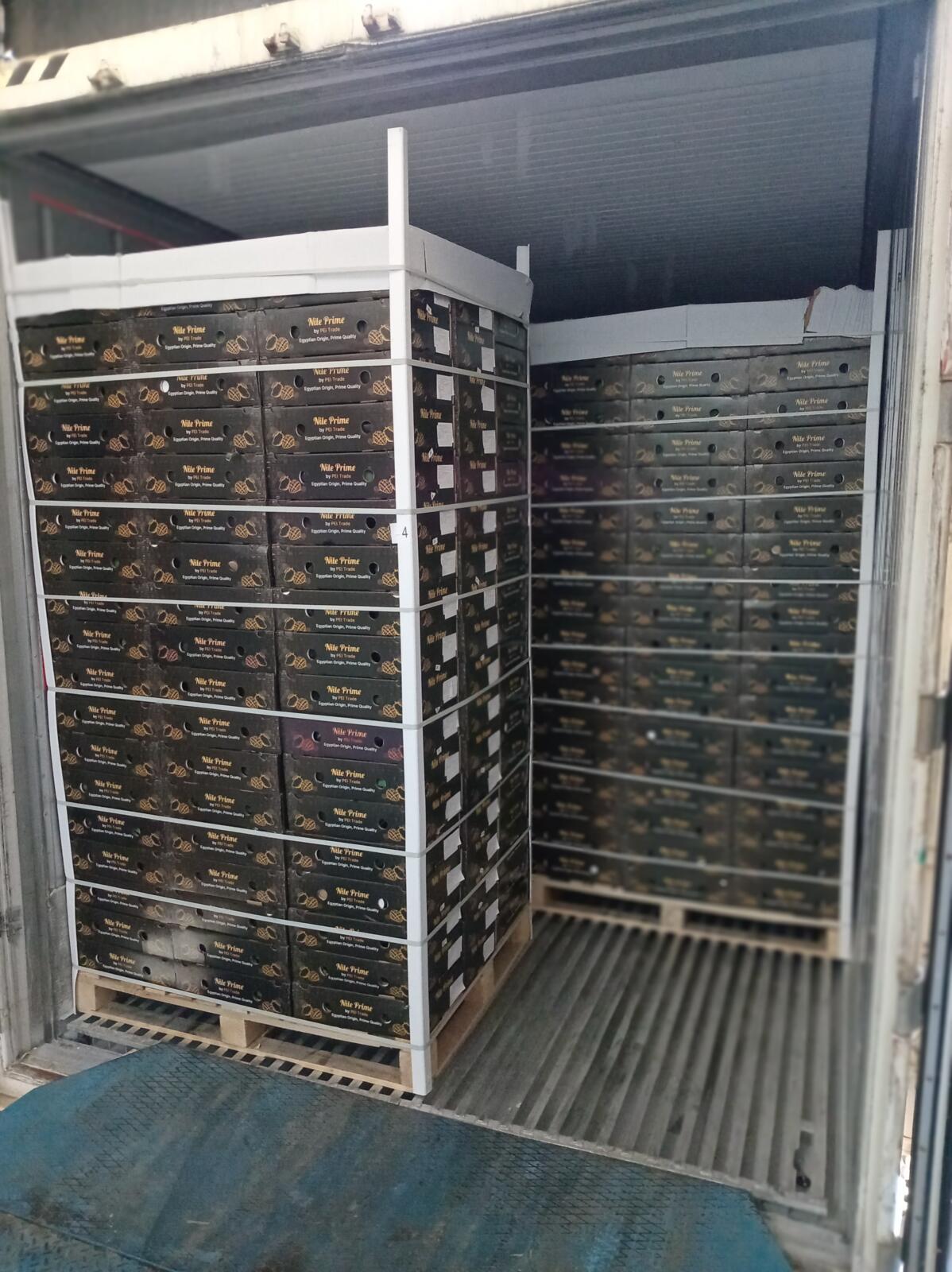
Most produce reefers run at 0 to 4 °C and mango is damaged there. We ship mature-green at 10 to 12 °C. Below about 10 °C you get chilling injury — grey patches, brown flesh, fruit that never develops flavour. The data-logger file comes with every container, whether you ask for it or not. Our full cold-chain temperature reference is public.
Fresh mango generally clears into the Gulf duty-free whatever its origin, so there is little tariff advantage for us to sell you — check the current schedule for your own port of entry before you budget. What tends to stop a container is a residue result or a missing declaration. That is where we spend our attention, and there is a section on it further down this page.
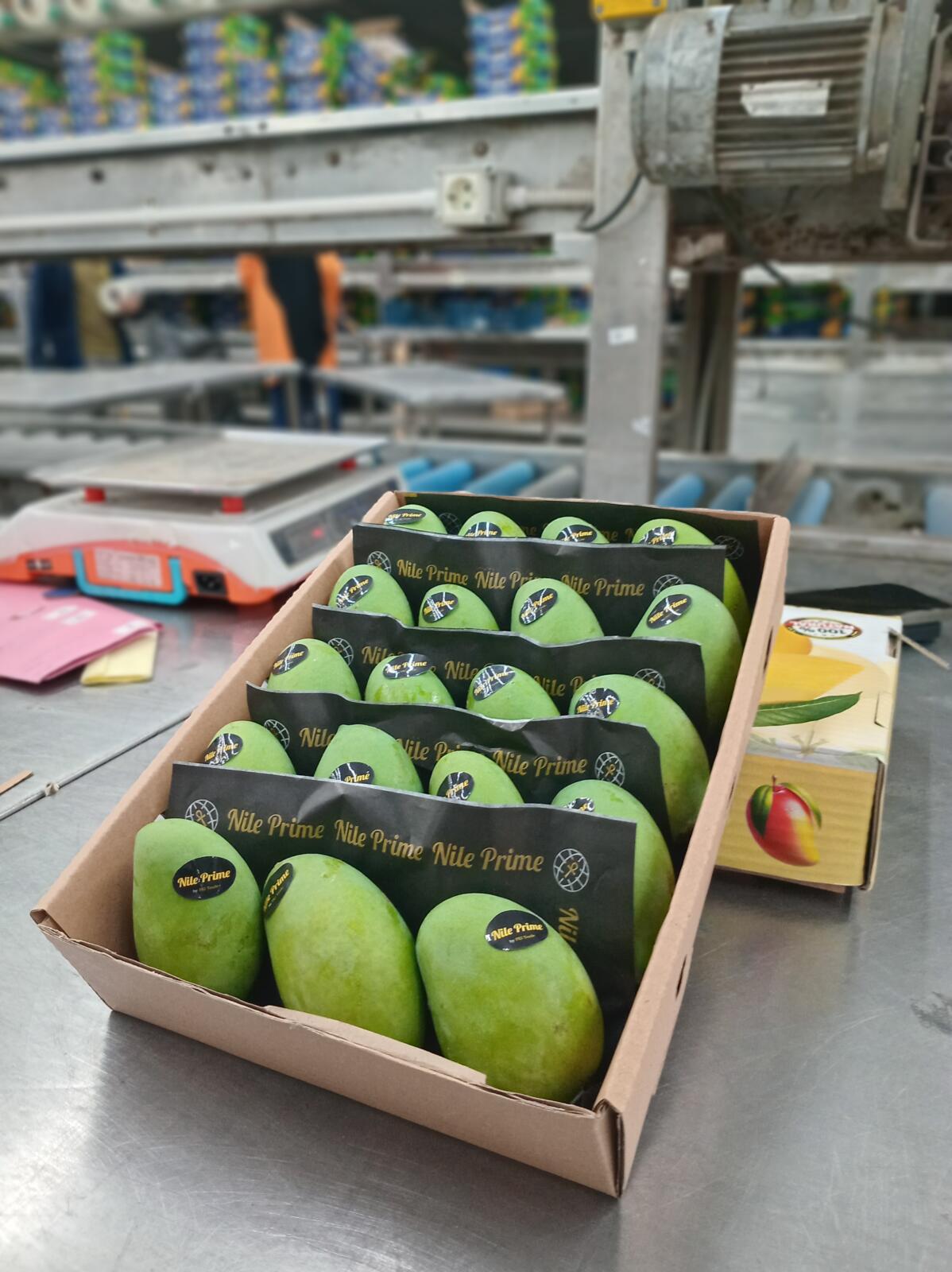
Count is how this trade talks about size. A count of 8 is eight fruit in a 5 kg carton, about 625 g each. We pack 6, 7, 8, 9, 10, 12, 14 and 16 — nothing else. There is no count 11, 18 or 20, and there is no 4 kg or 6 kg Egyptian mango carton.
| Count | Average fruit | Weight range |
|---|---|---|
| 6 | 833 g | 780–900 g |
| 7 | 714 g | 670–780 g |
| 8 | 625 g | 590–670 g |
| 9 | 556 g | 530–590 g |
| 10 | 500 g | 480–530 g |
| 12 | 417 g | 385–435 g |
| 14 | 357 g | 335–385 g |
| 16 | 313 g | 295–335 g |
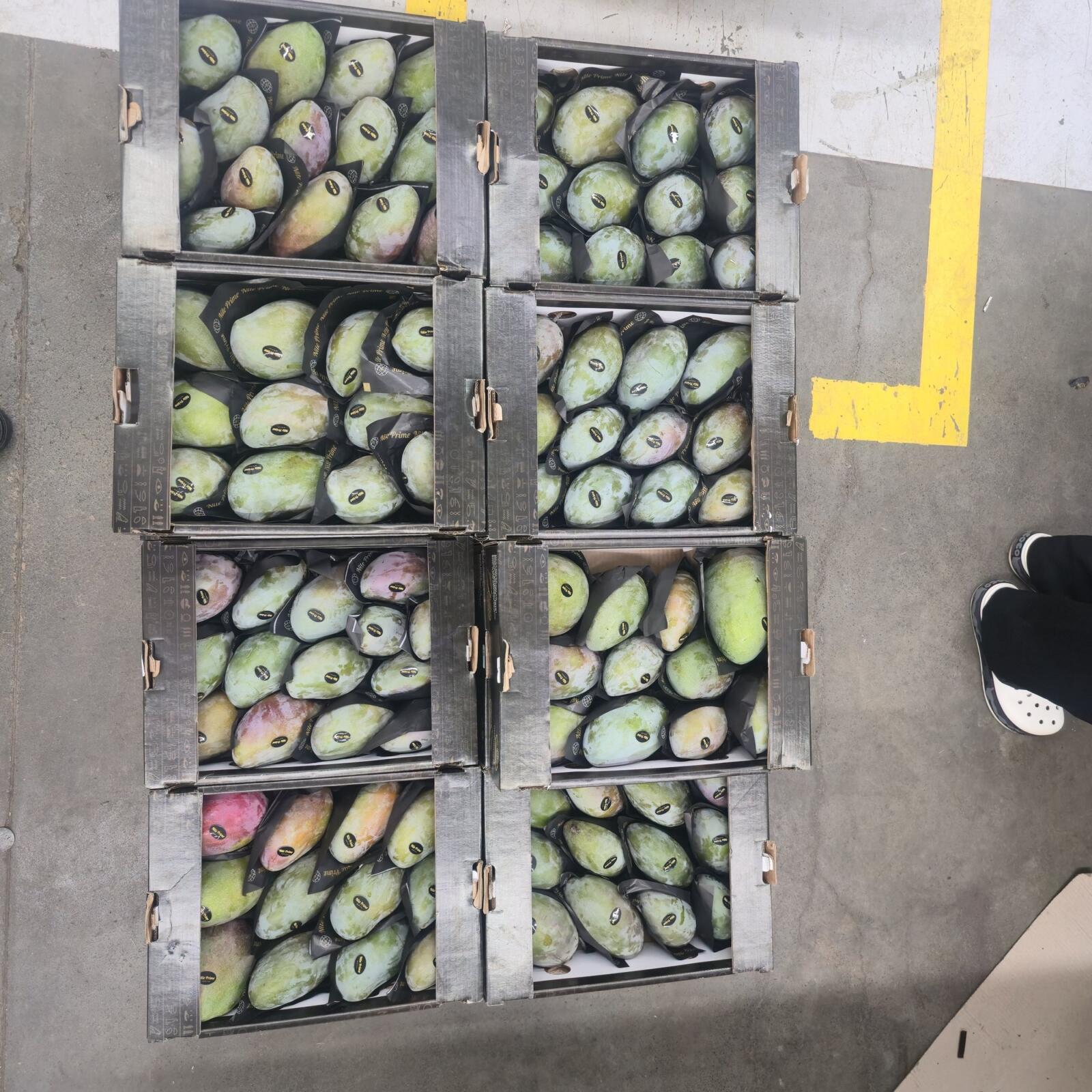
Eight cartons at the grading line, each packed to a different count. Photographed in August 2026 at the packing house we ship from — not a stock image.
| Variety | Fruit weight | Counts per 5 kg carton | Peak | Best for |
|---|---|---|---|---|
| Keitt | 500–800 g | 6 · 7 · 8 · 9 · 10 | Sep–Nov | Gulf and Europe. Stays green when ripe — agree a ripeness protocol |
| Kent | 400–600 g | 8 · 9 · 10 · 12 | Aug–Oct | The international benchmark variety. Fibreless |
| Naomi | 350–500 g, to 650 g from the best blocks | 10 · 12 · 14, and 8 from the best blocks | Jul–Sep | Gulf and Türkiye, where the name is already known |
| Zebda | 300–500 g | 10 · 12 · 14 · 16 | Aug–Sep | Gulf. Short shelf life — we do not recommend it for Europe |
| Owais | 250–400 g | 12 · 14 · 16 | Aug–Sep | Gulf, asked for by name |
On Brix, honestly. Brix at harvest is low for every mango variety — the sugar develops as starch converts during ripening, so a number quoted at harvest tells you very little. We do not publish a headline Brix figure because it would not mean anything. We measure it on the lot you are quoted and put the reading on the QC sheet that ships with the container. If your programme specifies dry matter at harvest instead, tell us the threshold and we will grade to it. See our grading and size standards reference.
A 40 ft reefer takes 20 standard pallets plus one euro pallet; a 20 ft takes 10. A loaded 40 ft of mango lands between 18.7 and 20.8 tonnes net against a 25-tonne legal ceiling. If someone offers you 24 or 26 tonnes, the arithmetic does not work — check it against the pallet count before you sign.
| Pack | Per pallet | Net per pallet | 40 ft reefer | Net load |
|---|---|---|---|---|
| 5 kg carton | 200 | 1,000 kg | 4,160 cartons | 20,800 kg |
| 4.5 kg carton | 200 | 900 kg | 4,160 cartons | 18,720 kg |
| 5 kg box | 180 | 900 kg | 3,744 boxes | 18,720 kg |
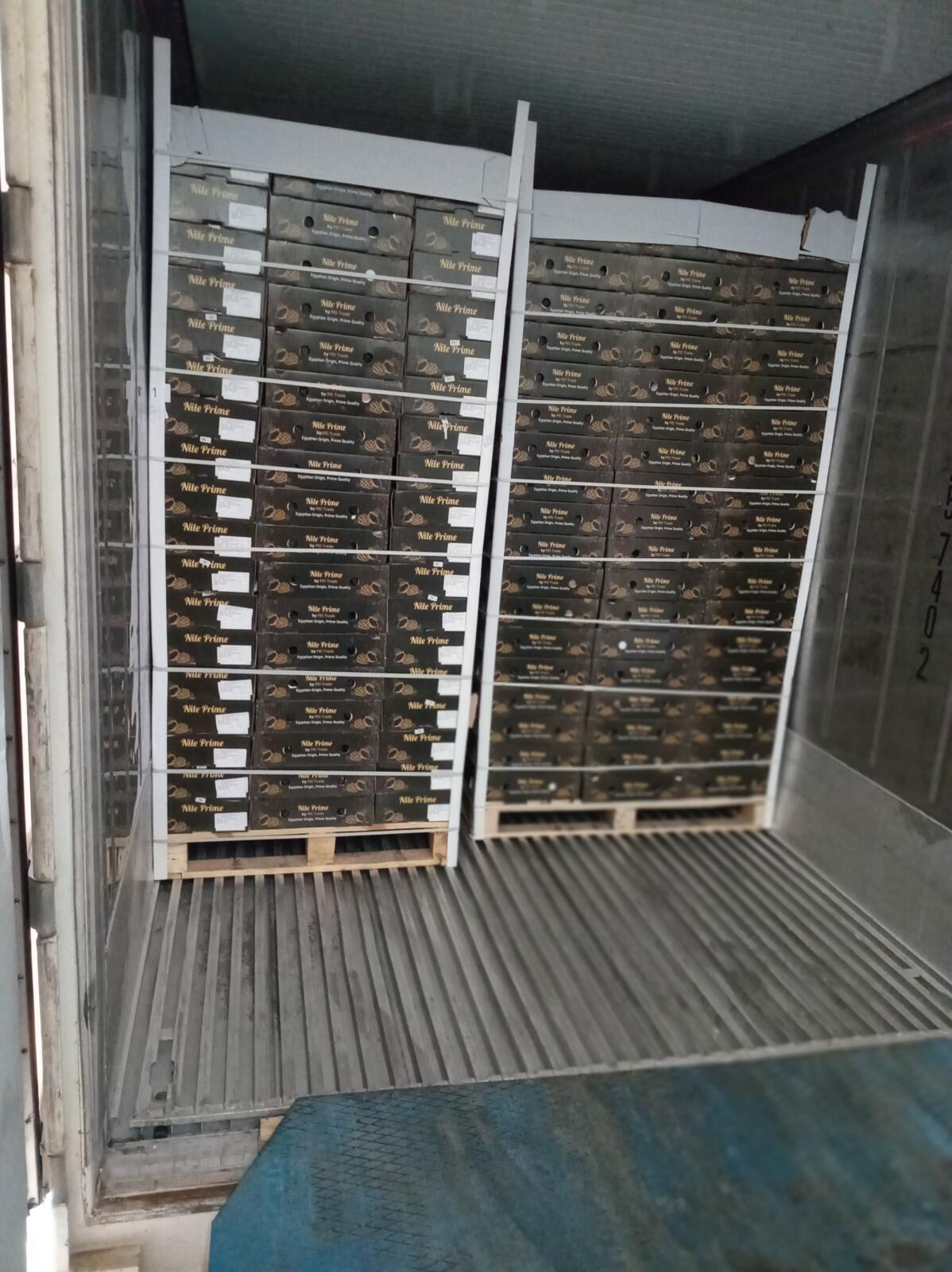
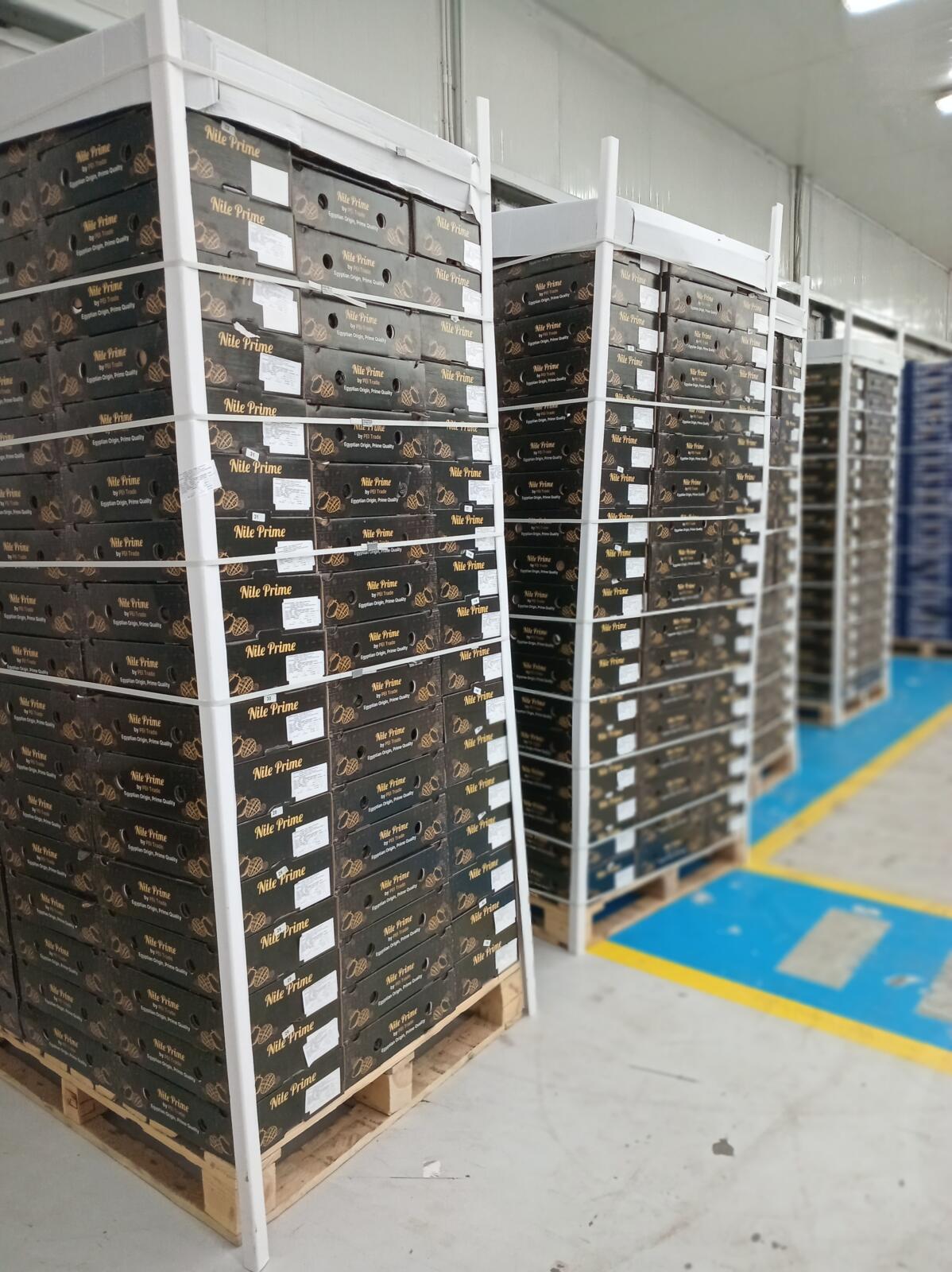
Egyptian mango has a reputation among buyers for being good fruit that is handled badly. That is a packhouse problem and it is fixable, so we publish what we actually do instead of writing that temperature is set according to commodity and destination.
In a high ambient port, a cold-chain break turns into a claim within days. Registered temperature, photographs of the load and a pre-shipment sample reading are what settle those arguments, so we produce all three as a matter of course.
We load from Damietta, Alexandria, Port Said and Ain Sokhna, on Incoterms 2020 — FOB, CFR, CIF, DAP or DPU. Two things about routing that most exporters will not tell you:
On Gulf transit times, we will not quote you a number from last year. Red Sea and Hormuz schedules have been moving all season and published transit times are stale almost as soon as they are written. Tell us the discharge port and we will come back with what the carrier confirms this week, with the sailing. Our public port and transit reference explains how the lanes work.
The UAE names Egypt on a list of origins that must attach a pesticide-residue certificate of analysis to every fruit and vegetable consignment. On that list, a failed test bans the exporting company, not the shipment. Dubai’s Al Aweer market also runs its own residue laboratory on site. That is two independent places to fail, and it is the reason a careless Egyptian supplier is a risk to every other Egyptian supplier.
So we test before we ship rather than after you ask, and the paperwork leaves with the vessel rather than following it. Background reading, if you want it: maximum residue limits and pre-shipment inspection.
What leaves with every container
Saudi buyers: the import licence is obtained at your end from the Ministry of Environment, Water and Agriculture, and it is quantity-scoped. Check the balance on it before we book freight — that is the single most common reason a first Saudi container sits.
A port and a volume is enough to start. You do not need to know the variety — tell us the market and we will recommend one.
Tell us these five and the first reply has a price in it
Anything you leave out we will ask about. None of it is required to start. B2B only — we use your details to answer you, and we do not add you to a mailing list.
Faster on WhatsApp
[email protected]
Sunday to Thursday, 09:00–17:00 Cairo time (UTC+2)
We reply within one working day, and we confirm quotes and contracts in writing by email so you have a record.
| When | What happens |
|---|---|
| Day 0 | You send the port and the volume. We confirm receipt the same working day. |
| Within 24 hours | Itemised quote — variety, count, carton, FOB or CFR or CIF, estimated sailing and arrival, suggested carriers. Quotes hold 24 to 72 hours because the market moves. |
| Day 1–2 | You confirm count, carton format, labelling and Incoterm. Proforma invoice and contract. |
| Day 1–3 | Payment arrangement and booking with the line. |
| Day 3–7 | Harvest, grading, pre-cooling, residue sampling, and your inspector if you appointed one. |
| Day 7+ | Stuffing, loading photographs, logger fitted, documents issued before the vessel sails. |
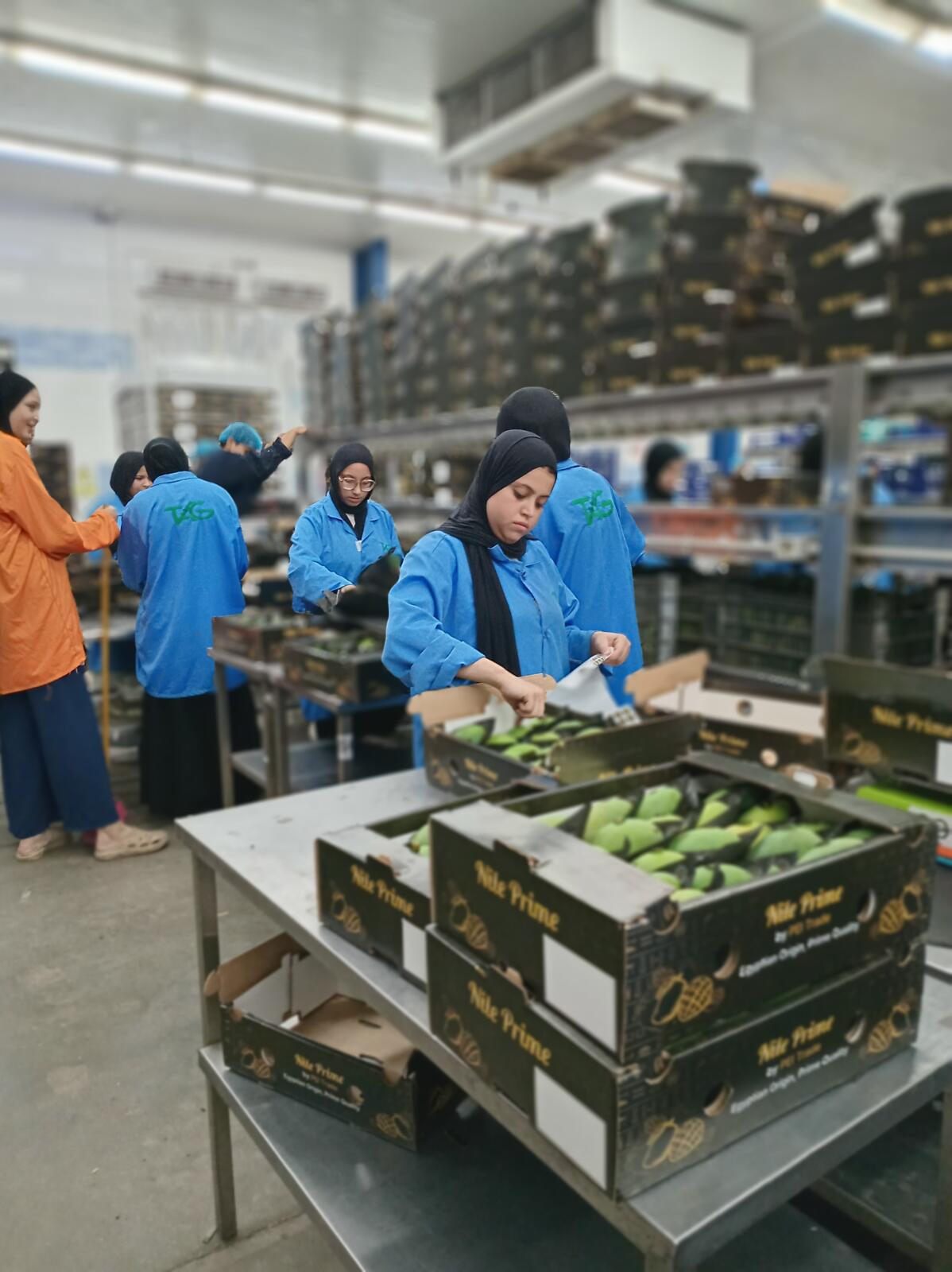
Produce fraud is a real problem in this trade and it runs in both directions. You should be careful with us, and we are careful too. Four things you can do that cost you nothing:
We will never change our bank details by email. If you get a message that appears to come from us asking you to pay a different account, it is not from us. Call the office before you send anything.
One full container. A 20 ft holds 10 pallets, a 40 ft holds 20 plus one euro pallet. We do not ship part loads of mango. Mixed varieties in one load are possible where the handling and temperature match.
For European retail, Kent first and Keitt when Kent is short — both are fibreless and that is what European shoppers expect. For the Gulf, Owais and Zebda are the varieties buyers ask for by name, and Keitt covers the late season into November. For Türkiye, Naomi and Keitt land in a market that already grows those names locally and recognises them.
Most fresh produce moves on telegraphic transfer, commonly a deposit against the balance before documents. Letters of credit and cash against documents are available if your bank requires them, but they are slow for a perishable cargo and few produce houses use them by default. Tell us what your side needs. Our payment methods reference sets out the trade-offs.
FOB, CFR, CIF, DAP and DPU, Incoterms 2020. If you are new to the difference, our Incoterms guide for fresh produce explains where risk actually transfers on a reefer shipment.
No. That is a United States rule and it is often quoted at European buyers by mistake. The EU wants a phytosanitary certificate carrying an official declaration against fruit fly under Directive (EU) 2019/523. Egypt has established fruit fly populations, so the country-free and area-free routes are not open to us — ours is pest-free production site with monthly official inspection through the three months before harvest.
Brix at harvest is low for every mango variety — the sugar develops as starch converts during ripening. If your buyer specifies a number, ask whether they mean at arrival or at ripeness, and tell us which. Many European programmes now specify dry matter at harvest instead, usually 14 to 16.5 per cent, because it predicts eating quality better. We measure and record whichever you specify on the QC sheet for your lot.
Yes. Send your artwork and carton spec with the enquiry. Lead time on printed cartons is longer than on plain, so raise it early in the season rather than late.
Photograph it on arrival, note the container and pallet numbers, and send it the same day with the data-logger reading. Where we disagree, the normal practice is that an independent surveyor decides. Agreeing the inspector in the contract before shipping saves an argument later.
Yes — Valencia and Navel oranges, pomegranates, onions, garlic, grapes, frozen strawberries and more. If you want a mixed programme across the year, say so and we will build one around the seasons.
A price comes back within one working day. The season runs to November.