Address
Work Hours
Monday to Friday: 7AM - 7PM
Weekend: 10AM - 5PM

Address
Work Hours
Monday to Friday: 7AM - 7PM
Weekend: 10AM - 5PM


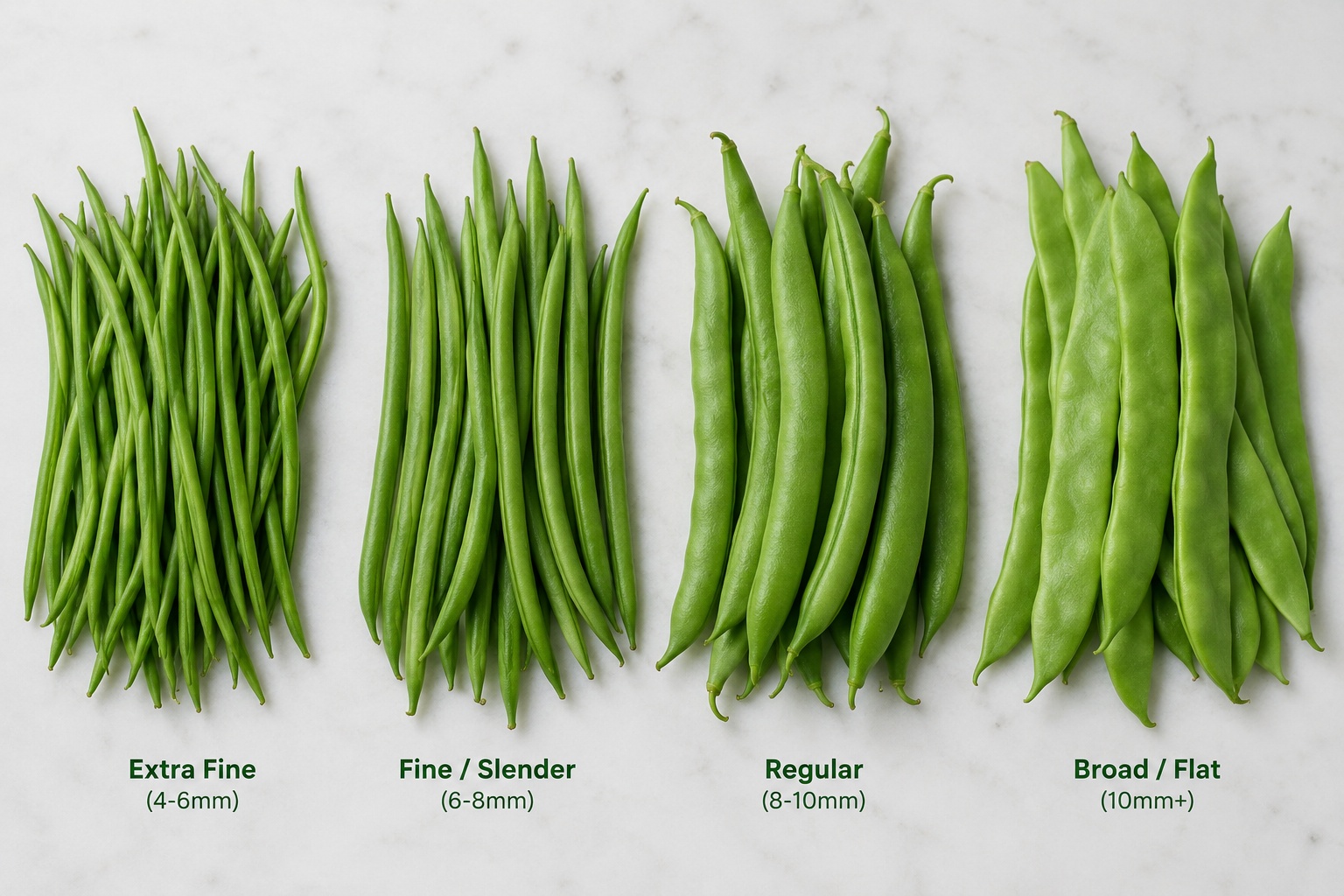
With green beans, the whole trade runs on one measurement: pod width. A slender extra-fine haricot vert and a chunky bobby bean are the same crop graded differently, and that grade decides the market and the price. This guide breaks down the Egyptian green bean types — by width and shape — and how to match them to your buyers.
Quick answer: Egyptian green beans are graded by pod width into extra-fine (under ~6 mm, the premium haricot vert), fine (~6–9 mm) and bobby (round, ~9 mm+). Flat (helda / romano) and yellow (wax) beans serve specialty markets. Extra-fine and fine beans command the highest prices in UK and EU retail; bobby beans suit foodservice and processing.
| Type | Pod width (approx.) | Best for |
|---|---|---|
| Extra-fine (haricot vert) | Under ~6 mm | Premium UK/EU retail; the highest value |
| Fine | ~6–9 mm | Premium retail & foodservice |
| Bobby (round) | ~9 mm+ | Foodservice, processing, value retail |
| Flat (helda / romano) | Flat pod | Specialty / selected markets |
| Yellow (wax) | Round / flat, yellow | Specialty markets |
The premium segment. Extra-fine beans — slender, under about 6 mm wide — are the classic haricot vert sold in UK and EU supermarkets, often topped-and-tailed in retail punnets. Fine beans (6–9 mm) follow closely. Both demand careful hand-picking and grading, and they carry the highest prices, which is exactly where Egypt’s winter supply is most valuable.
Bobby beans are the larger, rounder green beans (about 9 mm and up). They are quicker to pick and grade and suit foodservice, processing and value retail, where size and price matter more than the slender premium look.
Flat beans (helda / romano) have a broad, flat pod and serve specialty and selected markets, while yellow (wax) beans add colour variety for niche demand. These are smaller segments alongside the round-bean mainstream.
Grading by width is what makes a green bean program work: retail buyers specify a tight width band (e.g. extra-fine) for a uniform, premium pack, while foodservice may accept a broader grade at a lower price. Consistent grading is the difference between a clean, claim-free shipment and a rejected one.
For premium UK/EU retail, specify extra-fine or fine beans, usually topped-and-tailed. For foodservice or processing, bobby beans offer better value. Confirm the width band, length, preparation (whole vs trimmed) and pack with your supplier against your destination.
The French term for a slender extra-fine/fine green bean – the premium type, typically under about 9 mm wide.
Width: fine beans are slender (up to ~9 mm) and premium; bobby beans are rounder and larger (~9 mm+) and suit foodservice and processing.
Extra-fine beans command the highest prices in UK and EU retail.
Yes, in smaller volumes – flat (helda) and yellow (wax) beans serve specialty markets alongside the round-bean mainstream.
Primarily by pod width into extra-fine, fine and bobby, with length and straightness to specification.
How to cite this page
PEI Trade. “Egyptian Green Bean Types: Fine, Bobby & Flat.” peitrade.com, 2026. https://peitrade.com/egyptian-green-bean-types/
This page is part of our Egyptian Green Bean Export Guide hub.
Source the right Egyptian green bean with PEI Trade. Extra-fine and fine haricots verts, bobby beans and specialty types, graded to your width band and preparation, with GLOBALG.A.P. handling and a careful cold chain. Contact: [email protected] · WhatsApp +20 109 911 1918 · www.peitrade.com