Address
Work Hours
Monday to Friday: 7AM - 7PM
Weekend: 10AM - 5PM

Address
Work Hours
Monday to Friday: 7AM - 7PM
Weekend: 10AM - 5PM


Chilling injury damages produce held above freezing but below its safe minimum. Threshold temperatures, highest freezing points and arrival symptoms for 14 Egyptian export crops.
Chilling injury is damage caused by holding produce above its freezing point but below the lowest temperature the crop tolerates, and it is the single most common cause of a load that leaves Egypt sound and arrives unsellable. The damage is usually invisible at loading. It appears three to eight days later as pitting, scald, internal browning or fruit that simply refuses to ripen, by which time the container is at sea and nothing can be done.
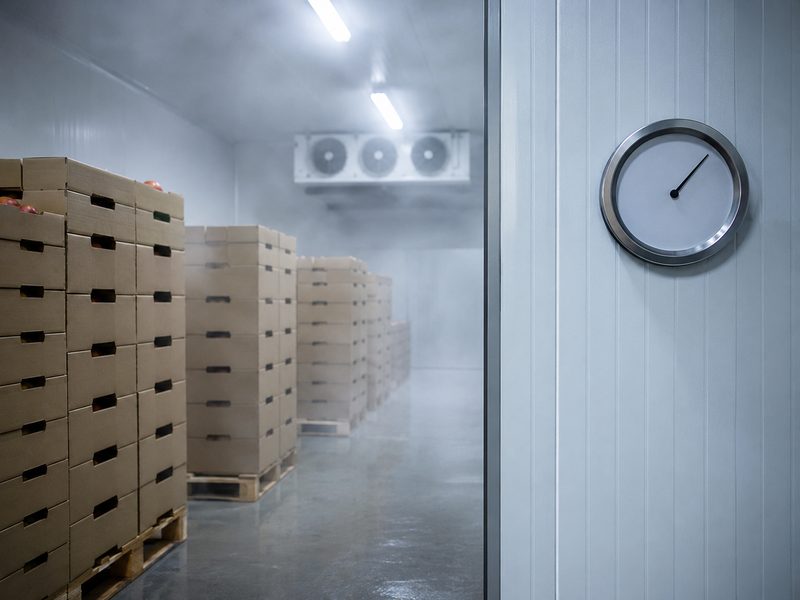
Two numbers matter for every crop and they are not the same number. The chilling threshold is the temperature below which physiological damage begins. The highest freezing point is the temperature at which the tissue actually freezes. Between them lies a band that is cold enough to hurt sensitive crops but nowhere near cold enough to look frozen. The holding temperatures that keep each crop inside that band are set out in the cold chain storage temperatures reference for fresh produce.
| Crop | Chilling threshold | Carriage set point | Highest freezing point | Symptom on arrival |
|---|---|---|---|---|
| Keitt and Kent mango | 10 C | 10 to 12 C | -1.4 C | Grey lenticel scald, uneven ripening |
| Valencia orange | 3 C | 4 to 6 C | -0.8 C | Rind pitting, brown staining |
| Navel orange | 3 C | 4 to 6 C | -0.8 C | Rind pitting, watery breakdown |
| Adalia lemon | 10 C | 10 to 13 C | -1.4 C | Pitting, membrane staining, red blotch |
| Murcott mandarin | 3 C | 4 to 5 C | -1.1 C | Rind collapse at the stem end |
| Wonderful pomegranate | 5 C | 5 to 7 C | -3.0 C | Husk scald, brown aril discolouration |
| Guava | 8 C | 8 to 10 C | -1.6 C | Surface pitting, failure to soften |
| Beauregard sweet potato | 13 C | 13 to 15 C | -1.3 C | Internal necrosis, hardcore when cooked |
| Taro (colocasia) | 7 C | 7 to 10 C | -0.9 C | Internal browning, soft rot on cut |
| Bell pepper | 7 C | 7 to 8 C | -0.7 C | Sheet pitting, calyx decay |
| Cucumber | 10 C | 10 to 12 C | -0.5 C | Water-soaked pitting, rapid decay |
| Green beans | 5 C | 5 to 7 C | -0.7 C | Russeting, rusty brown pitting |
| Table grapes | Not sensitive | -0.5 to 0 C | -2.7 C | Freezing damage only, below -2.7 C |
| Golden onion | Not sensitive | 0 to 2 C | -0.8 C | Freezing damage only, translucent scales |
Chilling injury is cumulative and latent. Cell membranes are damaged while the fruit is cold, but the visible symptoms develop when the fruit is warmed at the other end. A mango carried at 6 C for twelve days looks acceptable when the doors open at 6 C and turns grey and blotchy in the ripening room 48 hours later. This is why a pre-shipment inspection report can be clean and the arrival claim still valid, and why the temperature trace matters more than any photograph taken at loading.
A reefer holds one set point. In a mixed container the set point must respect the highest chilling threshold in the load, which means the most sensitive product wins and everything else is carried warmer than ideal. Sweet potato at 13 C and table grapes at 0 C cannot share a container at all. Mango at 10 C and guava at 8 C can, at 10 C, with a shelf-life penalty on the guava. Cross-check any combination against the reefer set point reference by crop and against ethylene sensitivity by crop before confirming a mixed booking, because a pair that agrees on temperature can still fail on ethylene.
Forced-air cooling moves cold air through the carton at high velocity, and a tunnel set to pull fruit down quickly will overshoot if it is not monitored. Chilling-sensitive crops should be cooled to their target with the tunnel set no lower than the crop threshold, never to a general 2 C room setting. The practical controls are covered in cooling methods for Egyptian produce.
PEI Trade is the exporter here, not a neutral reviewer. Thresholds vary with variety, maturity at harvest and growing region, so treat the figures above as working values to confirm against your own arrival records.
For a set point recommendation on a specific crop, variety and destination, or to review a temperature trace on a load that arrived with chilling injury, message the PEI Trade export desk on WhatsApp at +20 10 9911 1918.
