Address
Work Hours
Monday to Friday: 7AM - 7PM
Weekend: 10AM - 5PM
Address
Work Hours
Monday to Friday: 7AM - 7PM
Weekend: 10AM - 5PM


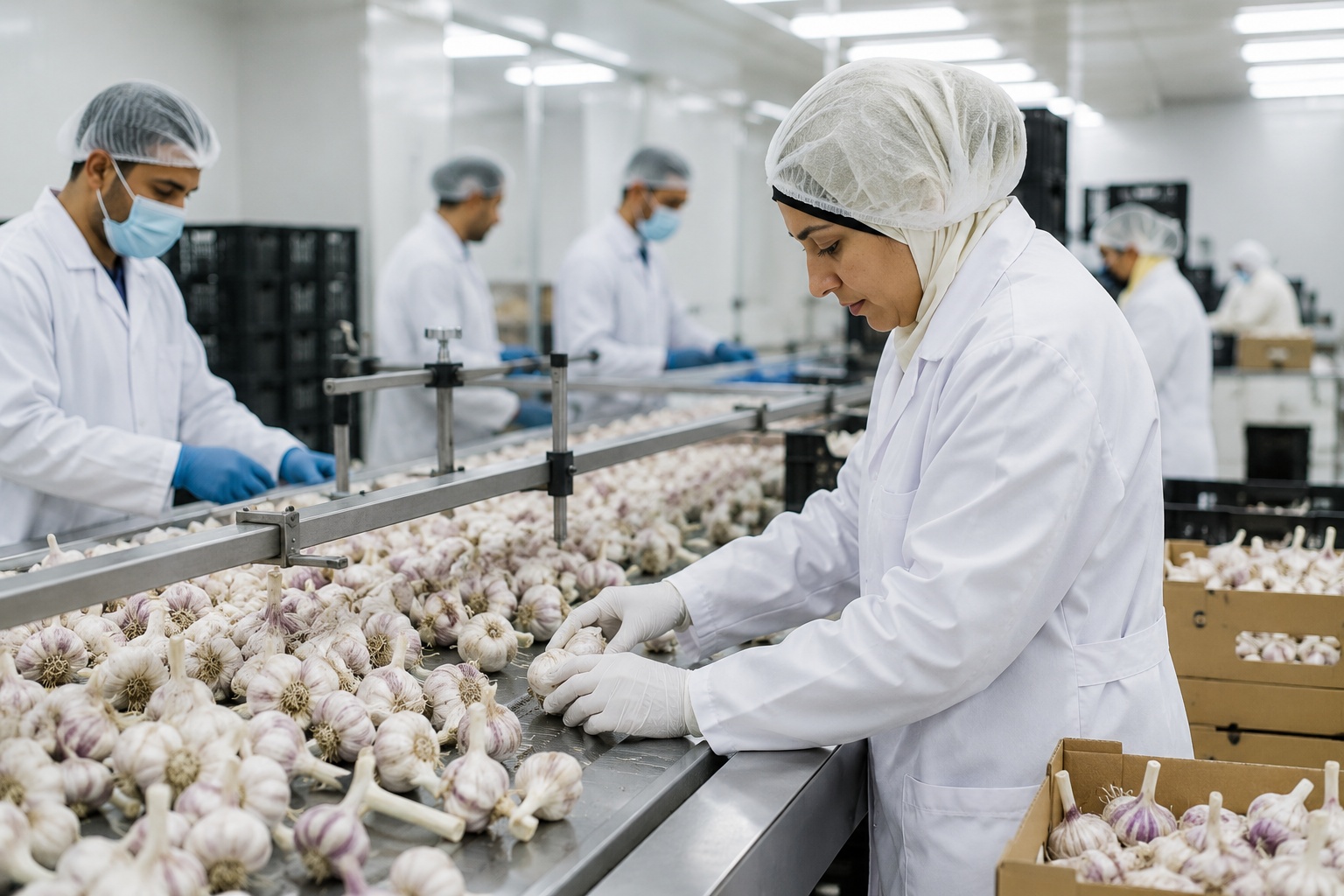
Garlic shares its main plant-health concern with onions — white rot — and, when sold dehydrated, adds a food-safety layer. This guide sets out what an importer and exporter need in place to move Egyptian garlic (fresh bulbs and dehydrated) cleanly: phytosanitary certification, the key disease, residue limits, marketing standards and certification.
Quick answer: To export Egyptian garlic you need a phytosanitary certificate (the key disease is white rot, Sclerotium cepivorum), compliance with destination MRLs (EU: Regulation (EC) No 396/2005) and the EU general marketing standard, plus GLOBALG.A.P., ISPM 15 wood packaging and lot-coded traceability. Dehydrated garlic additionally needs HACCP with ISO 22000 or BRCGS and microbiological control. Garlic trades under HS code 0703.20.
Every consignment travels with an official phytosanitary certificate from Egypt’s plant-quarantine authority, confirming inspection and freedom from quarantine pests and diseases. The headline concern for garlic (as for onions) is white rot (Sclerotium cepivorum), a soil-borne fungal disease, so field history and clean, sound bulbs matter. Garlic does not face the brown-rot pest-free-area regime that governs potatoes, which keeps its plant-health pathway comparatively simple — but the certificate is mandatory.
Egyptian garlic must meet destination MRLs — for the EU, Regulation (EC) No 396/2005. Approved products and pre-harvest intervals must be observed, and buyers may request residue test reports with shipments.
Garlic falls under the EU’s general marketing standard, meaning bulbs must be sound, clean, firm, sufficiently dry, free from damage and correctly labelled with origin. Consistent curing and grading are what keep consignments compliant and claim-free.
For EU and UK retail and processing, GLOBALG.A.P. (often with the GRASP add-on) is the baseline, alongside packhouse food-safety management (HACCP) and clear lot-coded traceability. Wood pallets and dunnage must be ISPM 15 compliant.
Dehydrated garlic (flakes, granules, minced, powder) is a processed food, so it requires full food-safety management: HACCP with a GFSI-recognised scheme (ISO 22000 / FSSC 22000 or BRCGS), strict hygiene, and microbiological control (including for pathogens such as Salmonella). Buyers routinely require micro test reports.
| Document | Purpose |
|---|---|
| Phytosanitary certificate | Confirms inspection & freedom from pests/disease (fresh) |
| Certificate of Origin | Proves Egyptian origin |
| EUR.1 movement certificate | Preferential tariff treatment where applicable |
| Commercial invoice & packing list | Customs valuation and contents |
| Bill of lading | Transport / title document |
| GLOBALG.A.P. certificate | Good agricultural practice assurance |
| Food-safety cert (dehydrated: ISO 22000 / BRCGS) | Processed-product assurance |
| Residue / micro test report | MRL (fresh) & microbiological (dehydrated) |
| ISPM 15 marked pallets | Compliant wood packaging |
White rot (Sclerotium cepivorum), a soil-borne fungus shared with onions; clean field history and sound bulbs are essential.
No – garlic is not subject to the brown-rot pest-free-area regime, but a phytosanitary certificate is still required.
Destination MRLs – for the EU, Regulation (EC) No 396/2005 – with approved products and pre-harvest intervals.
HACCP plus a GFSI scheme (ISO 22000/FSSC 22000 or BRCGS), strict hygiene and microbiological control (e.g. for Salmonella).
Garlic falls under HS code 0703.20.
How to cite this page
PEI Trade. “Egyptian Garlic Export Requirements.” peitrade.com, 2026. https://peitrade.com/egyptian-garlic-export-requirements/
This page is part of our Egyptian Garlic Export Guide hub.
Export Egyptian garlic the compliant way with PEI Trade. Phytosanitary documentation, GLOBALG.A.P. handling, residue compliance for fresh, and HACCP/BRCGS-level food safety with microbiological control for dehydrated — with EU/UK-ready paperwork. Contact: [email protected] · WhatsApp +20 109 911 1918 · www.peitrade.com