Address
Work Hours
Monday to Friday: 7AM - 7PM
Weekend: 10AM - 5PM
Address
Work Hours
Monday to Friday: 7AM - 7PM
Weekend: 10AM - 5PM


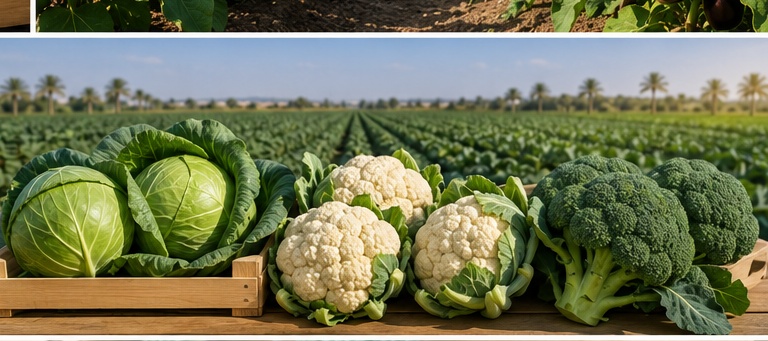
Cabbage, cauliflower and broccoli — the cool-season brassicas — are dependable Egyptian winter vegetables, grown in the milder months and shipped fresh (and frozen as florets) to the Gulf, the EU and Russia. Cabbage stores and travels well; cauliflower and broccoli are more perishable and demand a tight cold chain. This guide is the hub for importers: what Egypt grows, when it ships, the markets it serves, the specifications buyers ask for and the compliance behind every consignment.
Quick answer: Egypt is a counter-seasonal supplier of fresh cabbage (green, red, savoy), cauliflower (white) and broccoli (calabrese), plus frozen florets, shipping mainly through the European and Gulf winter. These are cool-season crops, exported from about October/November to April (peak winter). They are not chilling-sensitive and stored cold near 0°C at high humidity; broccoli is highly perishable and ethylene-sensitive. HS: cabbage 0704.90, cauliflower and headed broccoli 0704.10, frozen 0710.80. Markets include the Gulf, the EU and Russia. (Sources: ITC Trade Map, 2025; CBI.)
| Crop | Main types | Perishability |
|---|---|---|
| Cabbage | Green, red, savoy | Stores well (long) |
| Cauliflower | White (curd) | Moderately perishable |
| Broccoli (calabrese) | Green heads | Highly perishable |
These brassicas are cool-season crops, grown mainly through the Egyptian winter, with exports running from about October/November to April (peak winter). Cabbage’s good storage life extends its availability; cauliflower and broccoli are more closely tied to the fresh crop. Growing spans Nubaria, Beheira and the Delta. Exact windows shift year to year with planting and weather.
HS: cabbage 0704.90, cauliflower and headed broccoli 0704.10, frozen brassicas 0710.80.
All three need a phytosanitary certificate (brassica pests include diamondback moth, aphids and cabbage white), compliance with destination MRLs (EU: Regulation (EC) No 396/2005), and GLOBALG.A.P. with ISPM 15 packaging and traceability. Frozen florets additionally need food-safety management (HACCP, and where required BRCGS / ISO 22000) with an unbroken cold chain. Egyptian cabbage, cauliflower and broccoli are not on the EU’s enhanced official-controls list (Regulation (EU) 2019/1793), so they are not subject to increased border checks; standard MRL and phytosanitary rules apply.
Cabbage (green, red, savoy), cauliflower (white) and broccoli (calabrese), fresh and as frozen florets.
The cool season – exports run from about October/November to April, peaking in winter.
Cold near 0 degrees C at high humidity – they are not chilling-sensitive; broccoli is highly perishable.
The Gulf, the EU and UK (counter-seasonal), and Russia.
Cabbage 0704.90, cauliflower and headed broccoli 0704.10, frozen brassicas 0710.80.
How to cite this page. Reusing a figure from this guide? Please cite it and link to this page as the source.
PEI Trade. “Egyptian Cabbage, Cauliflower & Broccoli Export: The Complete Guide.” peitrade.com, 2026. https://peitrade.com/egyptian-cabbage-cauliflower-broccoli-export-guide/
Source Egyptian cabbage, cauliflower and broccoli with PEI Trade. Fresh heads and frozen florets to Gulf, EU and Russian buyers, with GLOBALG.A.P. handling, phytosanitary documentation and a cold, high-humidity cold chain. Contact: [email protected] · WhatsApp +20 109 911 1918 · www.peitrade.com